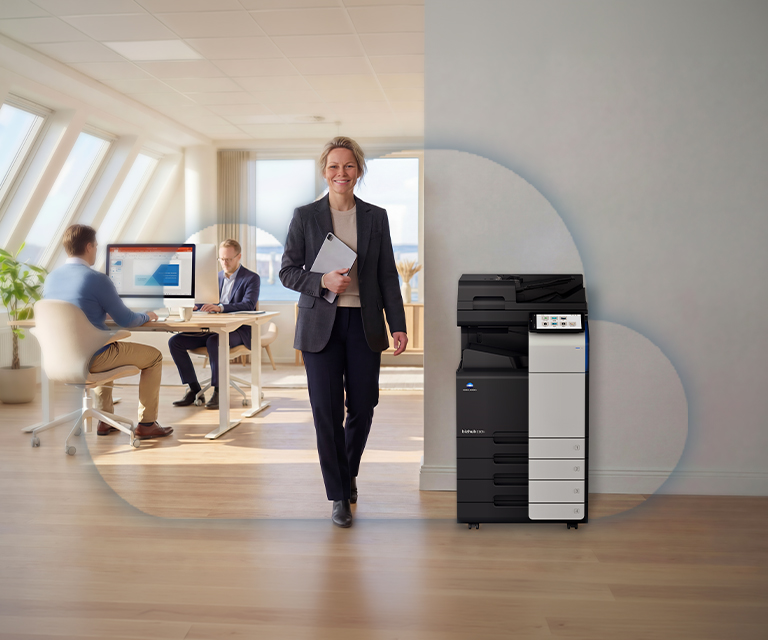



Artificial intelligence continues to transform how organisations operate, collaborate, and secure information. Economic pressure, a tightening labour market, and rapid technology advancements are driving Australian businesses to accelerate outsourcing, digitisation, and automation initiatives. AI now sits at the centre of this shift, enhancing everything from Managed Print Services and Cloud Print Services to Intelligent Information Management.
Here are the key Digital Workplace trends Konica Minolta expects to define 2026.

Trend 1: Rising costs accelerate outsourcing, digitalisation, and AI automation
Australian organisations continue to face cost pressures from inflation, supply chain disruption, changing trade dynamics, and rising operational expenses. Independent studies show that print and document management is one of the top areas where businesses seek savings and efficiency.
Outsourcing and AI-enabled automation play a critical role in cost management. Managed Print Services (MPS) and Cloud Print Services reduce the burden on internal IT teams through automation, remote monitoring, proactive support, and expert service delivery.
MPS helps reduce hardware, consumables, and operating costs while providing transparency and control. Cloud-based print infrastructures reduce onsite server investment and allow for flexible, consumption-based pricing that scales as needed.
Digitising documents remains a substantial cost saving measure. AI-powered capture, classification, and workflow automation reduce the hidden administrative burden of manual handling. Digital workflows reduce printing, paper, postage, and storage costs, while AI-driven systems provide fast, accurate access to information without physical archives.
Konica Minolta integrates AI into its Managed Print Services to predict consumables usage, automate replenishment, detect issues early, and minimise device downtime. Intelligent Information Management solutions streamline processes, support compliance requirements, and improve productivity across multiple locations and devices.

Trend 2: Paper persists, but AI-powered document processing becomes essential
Despite years of digital transformation, paper remains firmly embedded in many Australian workplaces. Only a small proportion of organisations operate in a fully paperless environment. As a result, businesses are prioritising intelligent document capture as a foundational step in their digital transformation efforts.
In 2026, AI-powered Intelligent Document Processing, Ingestion, and Capture will become increasingly crucial. This automates the capture, classification, extraction, and organisation of information from both physical and digital documents. This not only accelerates processing but also reduces errors and ensures greater consistency.
Beyond automation, AI-driven capabilities such as summarisation, translation, intelligent querying, and natural language understanding will make organisational information more accessible and reduce manual administrative effort.
In Australia, Konica Minolta supports this shift with comprehensive document processing and capture services that convert paper-based and rudimentary documents into digital formats. These services incorporate high speed scanning, AI-enhanced OCR and ICR for accurate text recognition, automated indexing and classification, and seamless integration into existing workflows to streamline operations. This modern approach helps organisations improve accuracy, enhance compliance, accelerate decision-making, and unlock more value from their information assets.


Trend 3: Growing demand for AI accountability and transparency
As AI adoption grows across the Australian workplace, organisations are placing greater emphasis on responsible, transparent, and auditable AI use. Challenges such as privacy, governance, and security are top concerns for businesses scaling AI initiatives.
According to IDC, nearly a third of organisations identify security, privacy, and governance as their most significant barriers to AI adoption. More than 75 percent of businesses rate transparency and explainability as critical.
Konica Minolta maintains strong commitments to ethical and responsible AI. The company has established internal frameworks for AI risk assessment, governance, and oversight.
By prioritising responsible AI, Konica Minolta aims to support customers in adopting technology that is safe, trustworthy, and aligned with real world business needs.